
Engine
How a Four-Stroke Gas Engine Works
Almost every gasoline engine on the trail, from a small 4-cylinder to a big V8, runs on the same simple cycle. Understand it once, and engine problems get much easier to reason about.
The Four Things an Engine Needs
A gasoline engine makes power by burning a mixture of air and fuel inside a sealed cylinder. The expanding gas pushes a piston, and the piston turns the crankshaft. For that to happen, every cylinder needs four things:
- Air: drawn in through the air filter and intake.
- Fuel: sprayed in by the injectors in the right amount for the air.
- Compression: the mixture squeezed tight so it burns fast and hard.
- Spark: fired by the spark plug at exactly the right moment.
If an engine cranks but won't start, or runs badly, one of these four is missing or mistimed. That simple checklist is the start of almost every engine diagnosis.
The Main Parts
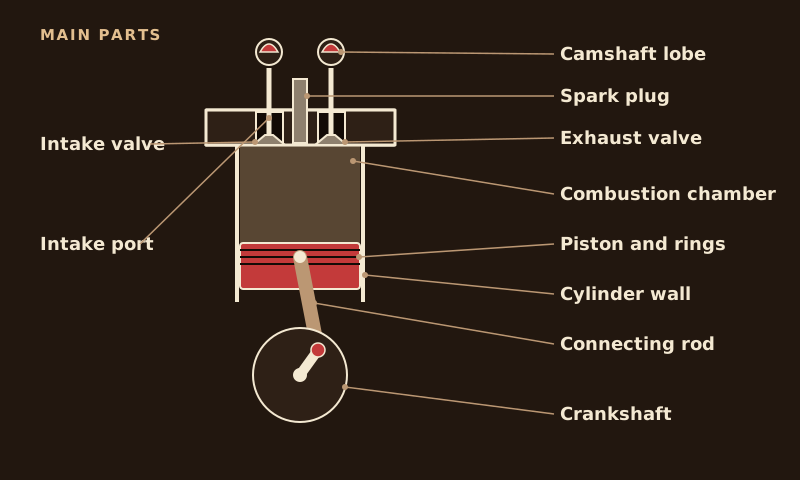
- Piston and rings: slide up and down in the cylinder. The rings seal the combustion pressure above the piston and keep oil below it.
- Connecting rod and crankshaft: turn the piston's up-and-down motion into rotation, like your legs and a bicycle's cranks.
- Valves: the intake valve lets the mixture in, the exhaust valve lets burnt gas out. Springs hold them shut.
- Camshaft: its lobes push the valves open at the right time. It is driven from the crankshaft by a chain, belt or gears.
- Spark plug: makes the spark that lights the mixture.
| Term | Meaning |
|---|---|
| TDC / BDC | Top dead center and bottom dead center: the highest and lowest points of the piston's travel. |
| Bore and stroke | The cylinder's diameter, and how far the piston travels from TDC to BDC. |
| Displacement | The volume all the pistons sweep in one stroke. A 3.6 L engine moves 3.6 liters of air per two crankshaft turns. |
| Compression ratio | The cylinder volume at BDC divided by the volume at TDC. Modern gas engines are typically around 10:1 to 12:1. |
The Four Strokes
A "stroke" is one trip of the piston, up or down. It takes four of them, two full turns of the crankshaft, to complete one cycle:
- Intake: the intake valve opens and the piston moves down, drawing the air and fuel mixture into the cylinder.
- Compression: both valves close and the piston moves up, squeezing the mixture into the small combustion chamber.
- Power: the spark plug fires. The burning mixture expands and drives the piston down hard. This is the only stroke that makes power.
- Exhaust: the exhaust valve opens and the piston moves up, pushing the burnt gas out into the exhaust.
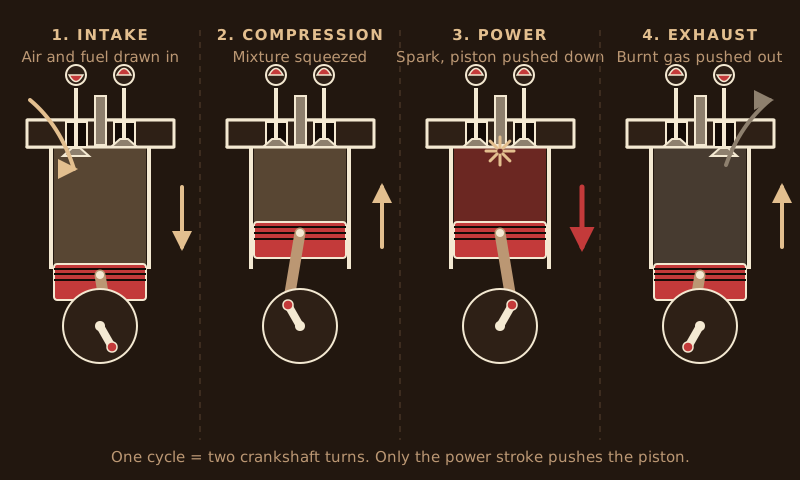
The three strokes that don't make power are carried through by the momentum of the flywheel and by the other cylinders. That's why more cylinders run smoother: a 4-cylinder gets a power stroke every 180° of crank rotation, a V6 every 120°, and a V8 every 90°.
Valve and Spark Timing
Everything has to happen at the right moment. The camshaft turns at exactly half the crankshaft's speed, so each valve opens once per cycle. The engine computer fires the spark plug a little before the piston reaches top dead center, called spark advance, so the mixture has time to burn and peak pressure lands just as the piston starts down.
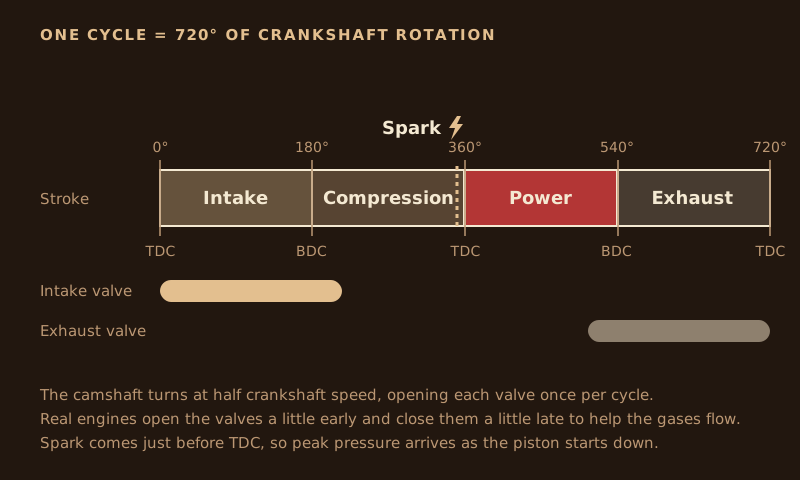
If the timing chain or belt jumps a tooth, valves and piston fall out of step. The engine may run poorly, not start at all, or in some engines the pistons can hit the valves.
What It Means on the Trail
Thinner air means less oxygen per stroke, so a naturally aspirated engine loses power as you climb. A common rule of thumb is about 3% per 1,000 feet. The engine computer trims fuel to match, but it can't add the missing air. Turbocharged engines lose much less.
Water doesn't compress. If the intake sucks in water, the piston can't finish its compression stroke and the engine stops instantly, often bending connecting rods. This is called hydrolock. Know where your air intake is, cross slowly behind a steady bow wave, and consider a snorkel. If the engine dies in deep water, don't try to restart it.
Every bit of dust that gets past the air filter wears the cylinder walls and rings, and worn rings mean lost compression. On dusty trails, check and clean or replace the air filter often, and make sure the airbox seals properly.
On a closed throttle, the pistons still have to compress air on every compression stroke, which slows the vehicle. In low range on a steep descent, that engine braking does most of the work and keeps your brakes cool.
Next: Engine Management and Fuel Trim covers how the engine computer decides how much fuel to inject.
← Back to the Tech Library