Drivetrain
Differentials: Open, Limited Slip and Locked
The differential is the reason your rig turns smoothly on pavement, and the reason it can sit stuck with one wheel spinning. Understand what it does with speed and torque, and you'll know exactly when a limited slip or a locker earns its keep.
Why We Need a Differential
In a turn, every wheel follows its own circle around the same center. The outer wheel's circle is bigger, so it has to roll farther, and therefore turn faster, than the inner wheel in the same amount of time.
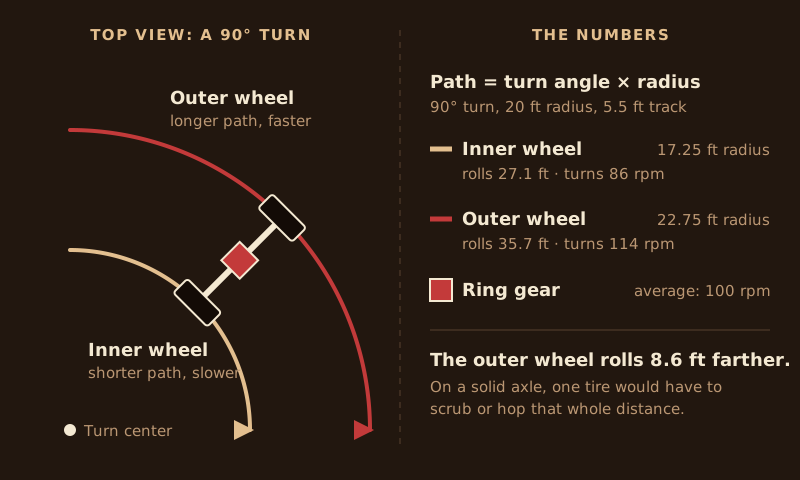
If both wheels were bolted to one solid shaft, they would be forced to turn at the same speed. One tire would have to scrub or hop to make up the difference. On pavement that means tire wear, heavy steering and a lot of stress on axle shafts.
The differential solves this. It takes power from the driveshaft and lets the two wheels on an axle turn at different speeds while still driving both of them.
The same problem exists between the front and rear axles, because the front wheels also travel a slightly different path from the rear. Full-time 4WD and AWD systems use a center differential in the transfer case for this. A part-time 4WD system has no center differential and locks the front and rear driveshafts together. That's why part-time 4WD should only be engaged on loose surfaces like dirt, sand, snow or mud, where the tires can slip a little.
How an Open Differential Works
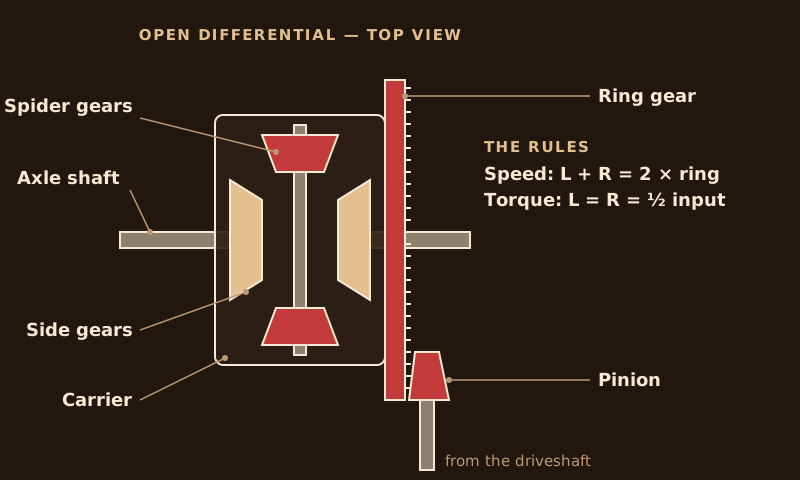
- Pinion: the small gear on the end of the driveshaft. It turns the ring gear 90° and reduces speed by the axle ratio (for example 4.10:1).
- Ring gear and carrier: the ring gear is bolted to the carrier, a case that spins with it.
- Spider gears: small bevel gears on a cross shaft inside the carrier. They are carried around with it, and they can also spin on their own shaft.
- Side gears: one on each side, splined to the axle shafts. The spider gears mesh with both of them.
Driving straight, the spider gears don't spin on their shaft at all. They act like a solid link, and both side gears turn with the carrier at the same speed. In a turn, the spider gears start to rotate: they add speed to one side gear and take exactly the same amount from the other.
The spider gears can only push equally on both side gears, like a balance beam. That is the key to the open differential's biggest weakness, as the math shows.
Speed and Force: The Formulas
Speed
The ring gear always turns at the average of the two wheels. Ring gear rpm = driveshaft rpm ÷ axle ratio.
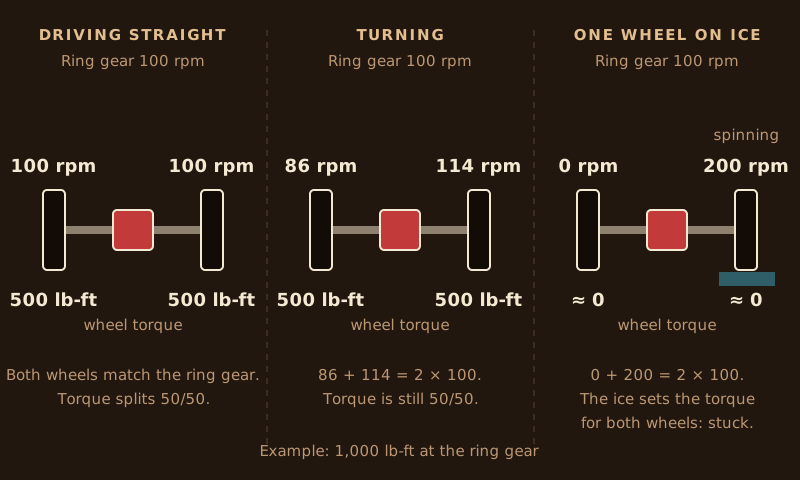
With the ring gear at 100 rpm, the wheels can turn 100 + 100 going straight, 86 + 114 in a turn, or 0 + 200 with one wheel stopped. That last one is why an open diff can spin one tire at twice the normal speed while the other one sits still.
Torque (force)
An open diff always splits torque 50/50, no matter how fast each wheel is turning (ignoring a little internal friction).
The catch is that a wheel can only take as much torque as its tire can push against the ground before it spins:
Grip × weight is the pushing force at the tire. Times the tire radius, it's the torque the wheel can use.
| Surface | Typical grip (μ) |
|---|---|
| Dry rock, dry pavement | 0.7 – 0.9 |
| Dry dirt, gravel | 0.5 – 0.6 |
| Loose sand | 0.3 – 0.4 |
| Mud, wet clay | 0.2 – 0.3 |
| Ice | about 0.1 |
| Tire in the air | 0 |
Since an open diff gives both wheels the same torque, the wheel with the least grip sets the torque for both. Once it starts spinning, the other wheel can't get any more, even if it's sitting on perfect rock.
Worked example
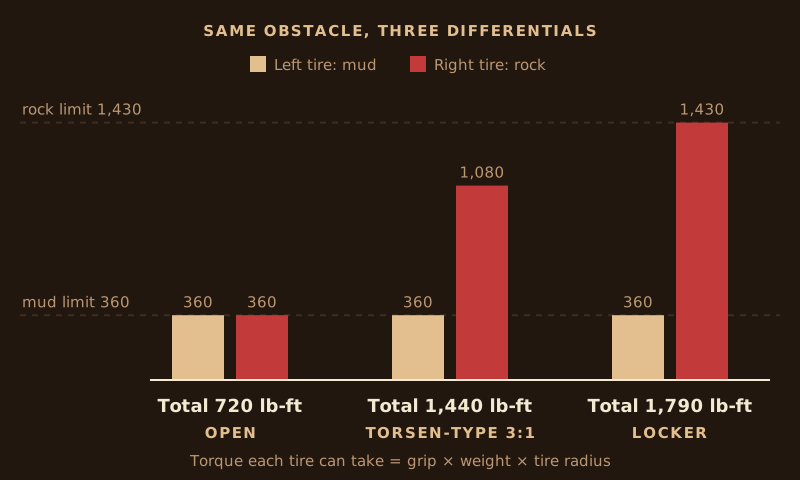
A loaded rig with about 1,300 lb on each rear tire and 33-inch tires (16.5 in, or 1.375 ft, radius). The left tire is in mud, the right tire is on dry rock:
- Right tire on rock: 0.8 × 1,300 lb × 1.375 ft ≈ 1,430 lb-ft before it spins.
- Left tire in mud: 0.2 × 1,300 lb × 1.375 ft ≈ 360 lb-ft before it spins.
- Open diff: both wheels get what the mud tire can take, 360 + 360 = 720 lb-ft in total.
If the obstacle needs more than 720 lb-ft, the mud tire just spins. Lift that tire off the ground entirely and the total drops to zero. This is exactly the problem limited slips and lockers are built to solve.
Limited Slip Differentials
A limited slip differential (LSD) still lets the wheels turn at different speeds, but it resists that difference. The resistance lets it send more torque to the wheel with more grip. How much more is described by the torque bias ratio:
A 3:1 bias ratio means the wheel with grip can get up to three times the torque of the slipping wheel.
Clutch-type limited slip
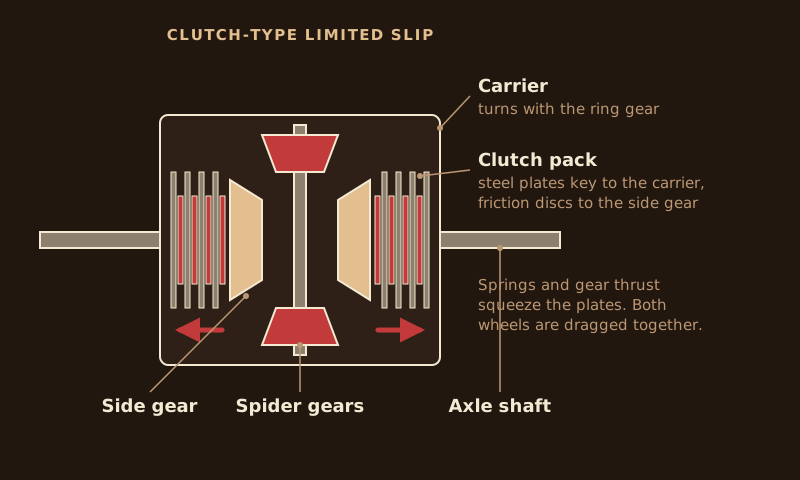
Stacks of clutch plates sit behind each side gear. Steel plates are keyed to the carrier, friction discs are splined to the side gear. Springs preload the stack, and under power the gear teeth push the side gears outward and squeeze it even harder. For one wheel to turn faster than the other, the plates have to slip against each other, and that friction carries torque over to the slower wheel.
- Strength: thanks to the spring preload, it still sends some torque to the wheel on the ground even when the other wheel is in the air.
- Weakness: the plates wear, and the effect fades over time. Most need gear oil with a friction modifier, and can chatter in tight turns when the oil is wrong or old.
Helical gear, torque-sensing (Torsen-type)
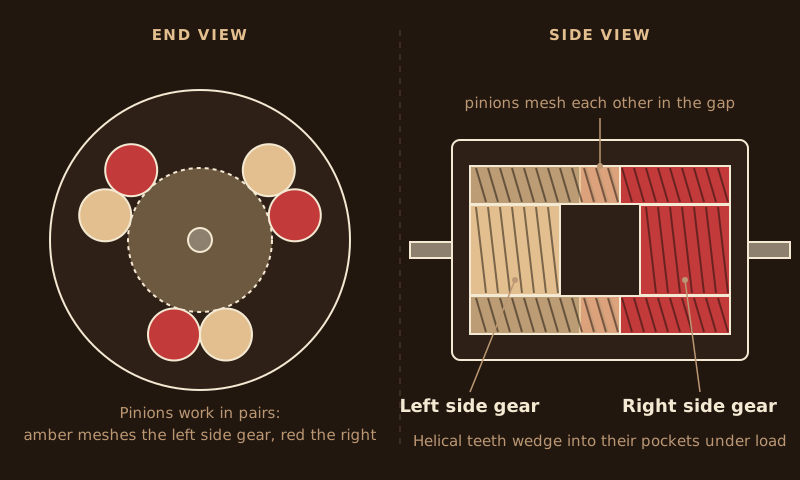
Torsen and similar gear-type units (Eaton TrueTrac is a common aftermarket example) have no clutches. They use helical gears, whose angled teeth push the gears sideways and into the walls of their pockets when they carry load. That friction resists the wheels turning at different speeds, in proportion to how much torque is going through. Bias ratios are typically around 2.5:1 to 4:1.
- Strength: smooth, automatic, no wear parts, behaves like an open diff on pavement.
- Weakness: it multiplies the torque on the slipping wheel. If that wheel is in the air, 3 × 0 is still 0, and it acts like an open diff. Lightly dragging the brakes adds load to the spinning wheel, and the diff multiplies that onto the wheel with grip.
Brake-based traction control
Many modern rigs have an open diff plus electronic traction control. When a wheel spins faster than the rest, the system brakes it. The brake gives the spinning wheel something to push against, so the open diff can send torque to the other side. Off-road modes and low range usually make this much more aggressive. It works well, but it's slower to react than a locker and builds a lot of brake heat on long climbs.
Locking Differentials
A locker forces both wheels on the axle to turn at exactly the same speed, like a solid shaft. Then the speed formula no longer applies, and the torque formula changes completely: each wheel gets as much torque as its tire can use. In the example above, that's 360 lb-ft on the mud side and the full 1,430 lb-ft on the rock, and with one wheel in the air, the other wheel still gets everything.
Automatic lockers
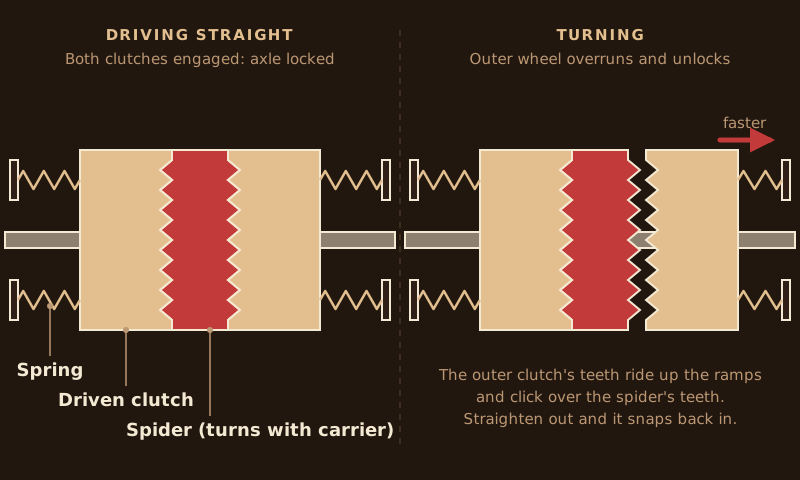
Automatic lockers, like the Detroit Locker or the "lunchbox" lockers that replace the spider gears inside an open carrier, are always locked when you're on the throttle. Spring-loaded clutches with ramped teeth are pushed into a central driver. In a turn, the outer wheel tries to go faster, its clutch rides up the ramps and ratchets over the teeth, and that wheel freewheels until you straighten out.
- Strength: always ready, nothing to switch, very strong.
- Weakness: clicks and clunks in turns, can make the vehicle push or pull when going on and off the throttle, and can be twitchy on ice or wet pavement. In a front axle, steering becomes much heavier.
Selectable lockers
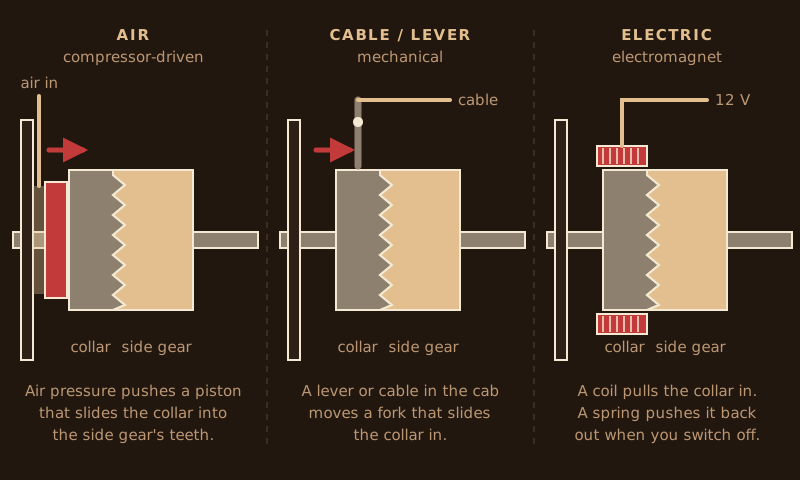
A selectable locker is an open differential until you switch it on. Then a collar slides into teeth on one side gear, locking it to the carrier. With one side gear locked, the spider gears can't rotate, and both axle shafts are locked together.
- Air (ARB Air Locker style): an onboard compressor sends air through a line into the axle, where it pushes a piston that engages the collar. Fast and positive; the air line and seals need to be kept tight.
- Mechanical: a lever or cable from the cab moves a fork that slides the collar. Simple and doesn't need air or electricity.
- Electric (Jeep Rubicon Tru-Lok, Eaton ELocker style): an electromagnet pulls the collar in, and a spring pushes it back when you switch off. Clean factory install; keep the wiring and connector at the axle protected.
Some older systems use vacuum or hydraulic actuators the same way. All of them give you an open diff for the road and a locker for the trail.
Spools and welded diffs
A spool replaces the whole differential with a solid piece, and a welded diff is an open diff with the spider gears welded solid. Both are locked all the time. They're cheap and strong, but they scrub tires, push the vehicle wide in every turn and load the axle shafts on pavement. They belong on dedicated trail and competition rigs, not daily drivers.
Side-by-Side Comparison
| Type | One wheel in the air | On pavement | Notes |
|---|---|---|---|
| Open | Stuck | Perfect | Cheap and strong. Traction control helps. |
| Clutch LSD | A little torque from preload | Good | Plates wear; needs the right oil. |
| Helical (Torsen-type) | Stuck, unless you drag the brakes | Perfect | No wear parts; great for mixed driving. |
| Automatic locker | Full torque to the other wheel | Noisy, can feel twitchy | Always on. Heavy steering in a front axle. |
| Selectable locker | Full torque to the other wheel | Perfect (unlocked) | Best of both; needs air, cable or wiring. |
| Spool / welded | Full torque to the other wheel | Poor | Trail and competition only. |
On the Trail
Engage lockers before the obstacle, not halfway up when a wheel is already spinning. Engaging with a spinning wheel shocks the gears, and the momentum you lost while spinning is hard to get back.
Lock the rear first. Add the front only if you need it. A locked front axle makes steering heavy and pushes the nose wide, which is the last thing you want on an off-camber turn.
The teeth may be sitting tip to tip. With the switch on, roll forward or back a few inches, or turn the steering slightly, and it will drop in. Most systems have an indicator light that only comes on once the locker is actually engaged.
A locked axle on pavement or dry rock in a tight turn winds up the axle shafts and joints until something slips or breaks. Front axle shafts and their joints are the usual casualties. Unlock as soon as you're through the obstacle.
With one wheel spinning, keep a light, steady throttle and gently drag the brake with your left foot. The brake loads the spinning wheel, and the differential sends that torque to the wheel with grip. In low range this is often enough to walk over the obstacle.
Related: How a Four-Stroke Gas Engine Works explains where that torque comes from in the first place.
← Back to the Tech Library