
Vehicle Electrics
Semiconductors
The parts inside every module, sensor and alternator on your rig: what capacitors, diodes and transistors do, and how current moves through them.
One of the building blocks of all modern electronics is semiconductors. Semiconductors can either conduct or block electric current. Because of this ability, they play a very important role in everything from relays to computer integrated circuits.
This chapter covers diodes, along with other parts used to build electrical circuits, such as resistors and capacitors. Diodes let current flow through them in one direction only. They have many uses, including suppressing sudden voltage surges (spikes) and converting alternating current to direct current in the alternator. Capacitors store electrical charge and are used to suppress noise and sudden voltage surges. Capacitors are also used in timer circuits to delay switching a component or system on or off.
This chapter covers: Capacitors · Current flow theory · Semiconductor theory · Diodes · Transistors
Capacitors
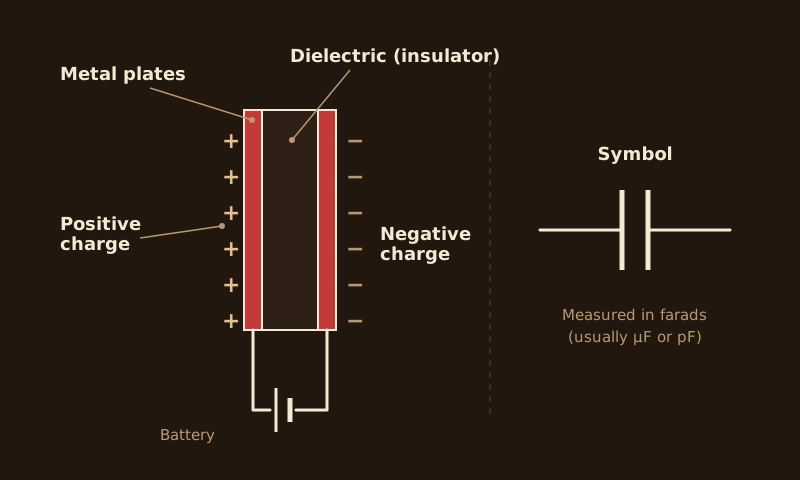
A capacitor is two metal plates separated by a thin insulator, called the dielectric. Connect it to a voltage and electrons pile up on one plate while the other plate gives them up. No current crosses the insulator, but the capacitor now holds a charge, a bit like a tiny, very fast battery.
Once it's charged, a capacitor blocks steady DC. It still reacts to anything that changes quickly. That is why it's used to soak up spikes and electrical noise: it absorbs the sudden rise and releases it slowly. Charging a capacitor through a resistor takes a predictable amount of time, which is how simple timer circuits delay switching something on or off.
Radio noise suppressors on alternators and fuel pumps, filter capacitors inside every ECU, and the delay in courtesy lights and some timer relays.
Current Flow Theory
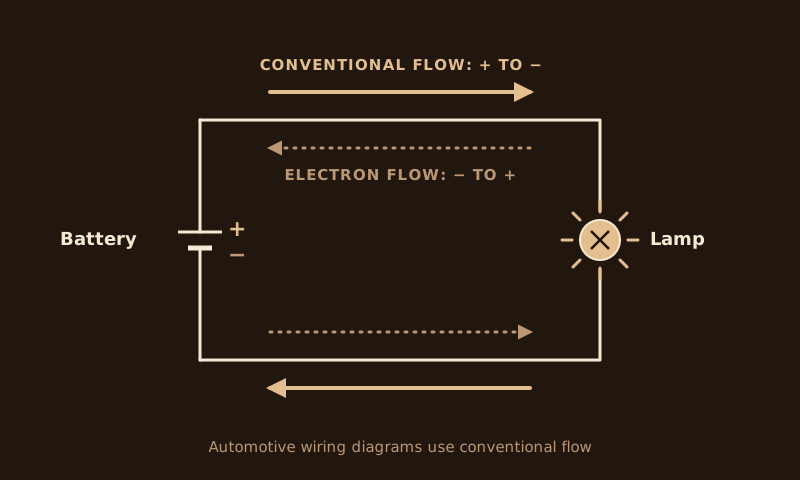
Current is the movement of electrons through a conductor. There are two ways to describe its direction:
- Conventional flow says current flows from positive (+) to negative (−). This is the older convention, and it's what automotive wiring diagrams and schematic symbols are drawn around.
- Electron flow describes what really happens: electrons are negative, so they move from negative (−) to positive (+).
Both describe the same circuit and both give the same answers. What matters is to pick one and stick with it. For working on vehicles, use conventional flow, because that is how the diagrams and the arrows on diode and transistor symbols are drawn.
Semiconductor Theory
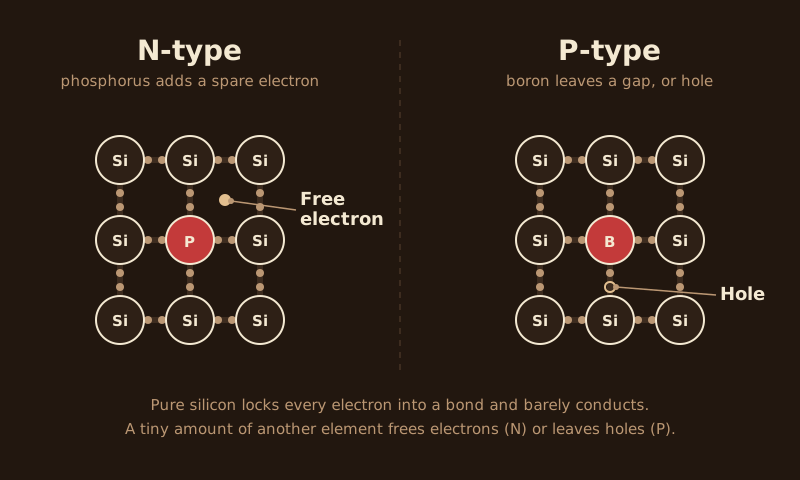
A semiconductor is a material that conducts better than an insulator but worse than a metal. Silicon is the most common. Each silicon atom has four outer electrons, and in a crystal it shares them with its four neighbors. With every electron locked into a bond, pure silicon barely conducts.
Adding a tiny amount of another element, called doping, changes that:
- N-type silicon is doped with an element such as phosphorus, which has five outer electrons. The fifth has no bond to fill, so it is free to move and carry current. N stands for negative, because the extra carriers are electrons.
- P-type silicon is doped with an element such as boron, which has only three outer electrons. That leaves a gap in one bond, called a hole. Neighboring electrons jump into the hole, so the hole moves through the crystal like a positive charge. P stands for positive.
On their own, both types simply conduct. The useful part happens where P and N meet, which is how diodes and transistors are made.
Diodes
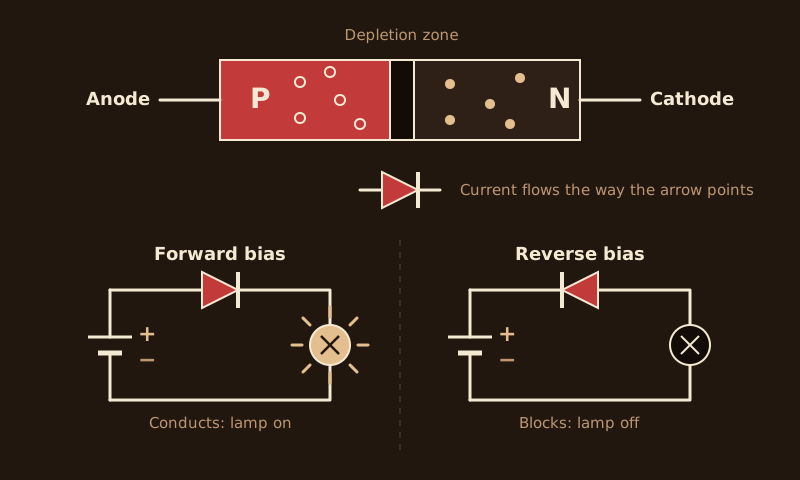
A diode is a piece of P-type silicon joined to a piece of N-type. At the junction, free electrons from the N side fill holes on the P side, leaving a thin zone with no free carriers, called the depletion zone. It acts as a barrier.
- Forward bias: positive to the P side (anode) and negative to the N side (cathode) pushes carriers across the barrier, and the diode conducts. A silicon diode drops about 0.6–0.7 V when it conducts.
- Reverse bias: connect it the other way and the barrier widens, and the diode blocks current.
The diode symbol is an arrow pointing the way conventional current is allowed to flow, with a bar on the cathode end. On the part itself, the cathode is usually marked with a band.
The alternator's rectifier uses diodes to turn its AC output into DC. Clamping diodes across relay and solenoid coils absorb the voltage spike when the coil switches off. Zener diodes, built to conduct in reverse at a set voltage, are used to regulate and protect circuits.
Transistors
A transistor is a sandwich of three semiconductor layers, either N-P-N or P-N-P. The three connections are the collector, the base (the thin middle layer) and the emitter.
A small current into the base lets a much larger current flow from collector to emitter. Take the base current away and the large current stops. That makes the transistor a solid-state switch with no moving parts, much like a relay, only far faster. Between fully off and fully on it can also act as an amplifier.
On the symbol, the arrow is on the emitter and points the way conventional current flows. An NPN emitter arrow points out; a PNP arrow points in.
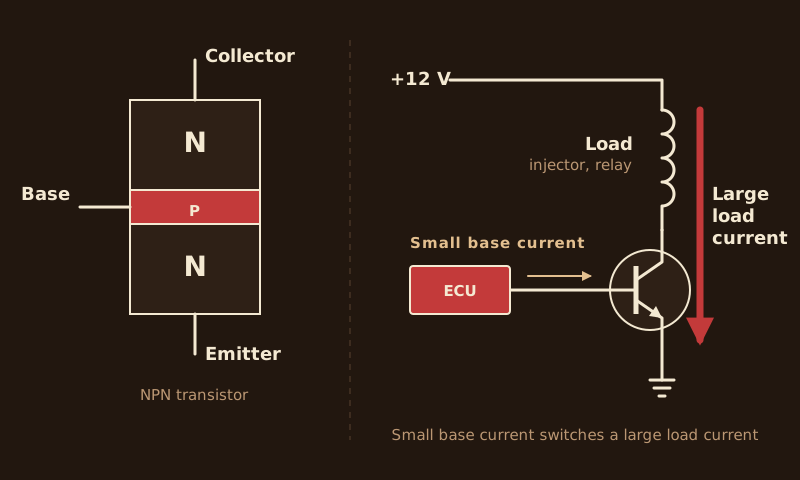
The ECU's drivers that pulse the fuel injectors, fire the ignition coils and switch relays are transistors, usually switching the ground side of the circuit. Voltage regulators and electronic modules are built from thousands of them.