
Vehicle Electrics
Basic Automotive Electricity
Voltage, current and resistance are easier to picture as water in a pipe. Learn these three and how they relate, and most electrical problems on your rig start to make sense.
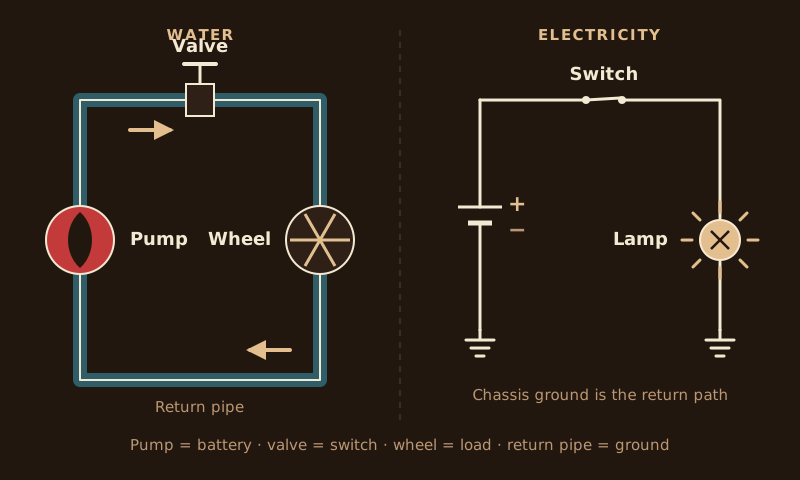
You can't see electricity, but it behaves a lot like water in a plumbing system. Every drawing in this article puts the water version on the left and the electrical version on the right.
| Term | Water | Unit |
|---|---|---|
| Voltage (V) | Pressure | Volts |
| Current (I) | Flow | Amperes (amps) |
| Resistance (R) | Restriction | Ohms (Ω) |
| Power (P) | Work done by the flow | Watts |
In this article: Voltage · Current · Resistance · Ohm's law · Power · The complete circuit · Three common faults
Voltage: The Pressure
Voltage is the electrical pressure that pushes current through a circuit. In a water tank, deeper water pushes harder on the outlet. In a car, the battery and alternator provide the push.
Like water pressure behind a closed tap, voltage is there even when nothing is flowing. That is why you can measure battery voltage with everything switched off.
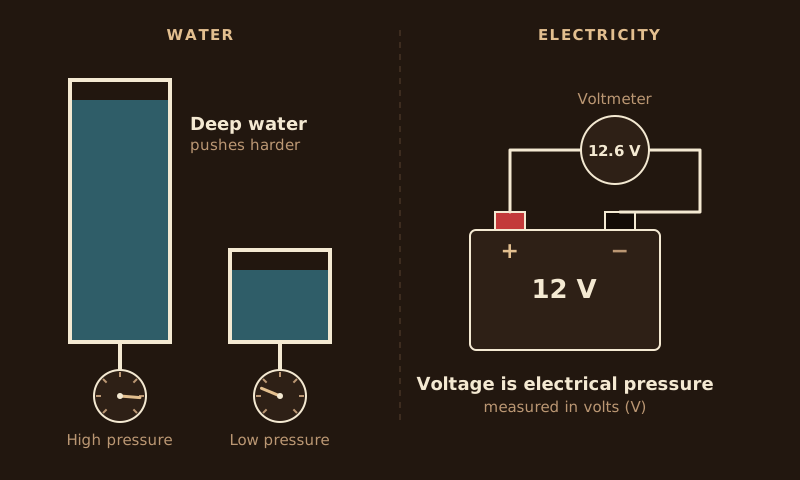
Cars and trucks run on a 12 V system. A healthy, fully charged battery reads about 12.6 V at rest. With the engine running, the alternator should hold roughly 13.5–14.5 V.
Current: The Flow
Current is how much electricity actually flows through the circuit, the way gallons per minute describe how much water moves through a pipe. It is measured in amperes, usually shortened to amps.
To measure flow you have to put the meter in the pipe, so the water passes through it. An ammeter works the same way: it goes in line with the circuit, never across the battery. A clamp-on ammeter does the same job by sensing the wire's magnetic field, without breaking into the circuit.
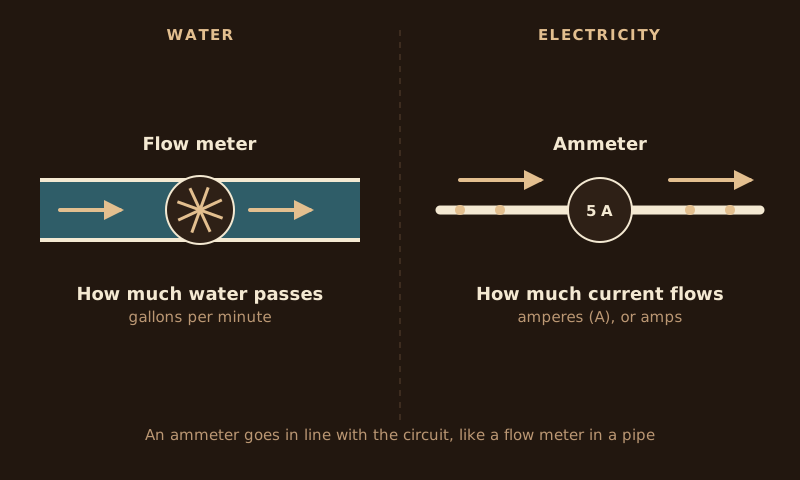
Fuses are rated in amps. A small lamp draws a few amps, a fan motor 10–20 A, and a starter motor well over 100 A while cranking.
Resistance: The Restriction
Resistance is anything that opposes current flow, like a narrow spot in a pipe. With the same pressure, a restriction lets less water through. With the same voltage, more resistance lets less current through.
Some resistance is wanted: every lamp, motor and heater has resistance, and that is where the work gets done. Unwanted resistance is the problem: corroded terminals, loose grounds, frayed or undersized wire. It wastes voltage before it reaches the load.
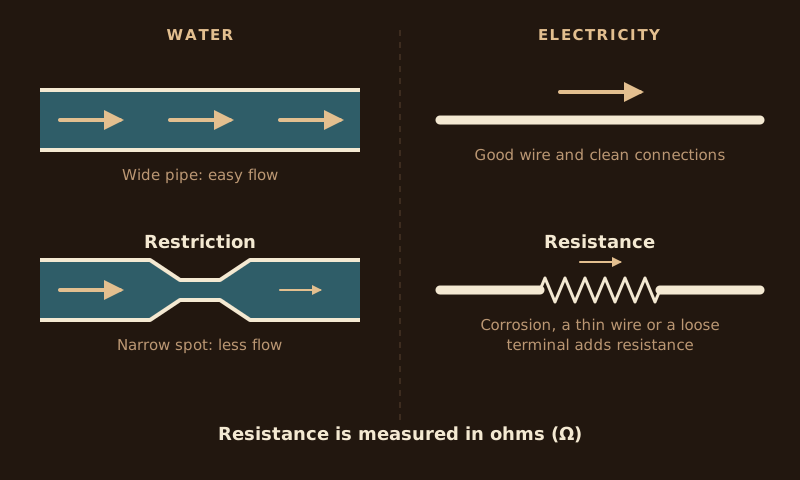
Resistance is measured in ohms with an ohmmeter, always with the circuit unpowered.
Ohm's Law
Voltage, current and resistance are tied together. Know any two and you can work out the third:
The triangle is an easy way to remember it. Cover the value you want, and what's left shows how to get it: V over I means divide, I next to R means multiply.
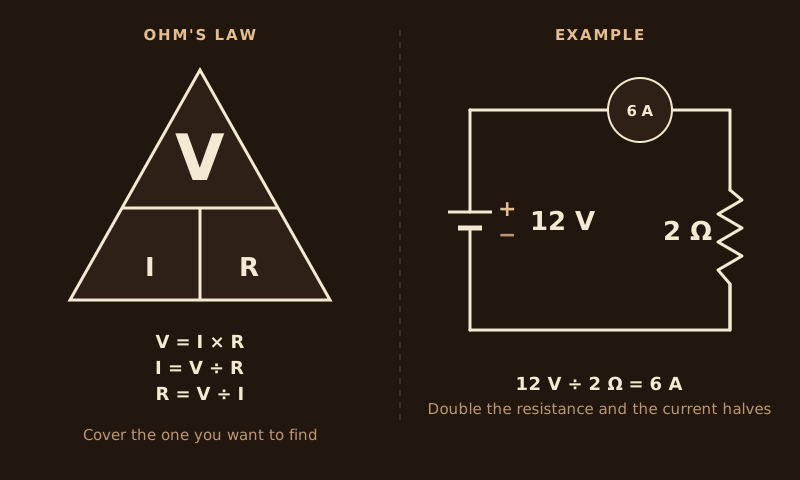
In practice, this is why a bad ground dims a light: the extra resistance lowers the current, even though the battery voltage hasn't changed.
Power: The Work
Power is how much work the electricity does, like a stream of water turning a wheel. Higher pressure or more flow means more work. It is measured in watts:
A 55 W headlight bulb on a 12 V system draws about 4.6 A (55 ÷ 12). This is the math behind choosing fuses and wire sizes for any accessory you add.
An electric winch under heavy load can draw several hundred amps. That's why winch cables are so thick and run as short as possible straight to the battery.
The Complete Circuit
Water only does work if it can flow around a loop: the pump pushes it out, it turns the wheel, and the return pipe brings it back. Electricity is the same. Current needs a complete path from the battery, through the load, and back to the battery.
Every working circuit has the same parts:
- Power source: the battery or alternator (the pump).
- Protection: a fuse or circuit breaker.
- Control: a switch or relay (the valve).
- Load: the lamp, motor or module that does the work (the wheel).
- Return path: in a vehicle, usually the metal body and frame, called chassis ground (the return pipe).
Three Common Faults
Most electrical problems come down to one of these:
- Open circuit: a break in the path, like a closed valve or a cut pipe. Nothing flows, and the load is dead. Causes: a blown fuse, broken wire, failed switch or unplugged connector.
- Short circuit: current finds a path around the load, like a burst pipe dumping water before it reaches the wheel. Resistance drops, current shoots up, and the fuse blows. Usually chafed insulation touching metal.
- High resistance: a partly clogged pipe. Something still flows, but not enough. Lights are dim, motors run slow, and connections may get hot. Usually corrosion, a loose terminal or a poor ground.